
Blog
Published On: 19/06/2026
Ayodhya Master Plan 2031: Key Developments Every Investor Should Know
Ayodhya Master Plan 2031 reveals the next real estate hotspots. Explore new townships, airport growth, and high-potential investment zones
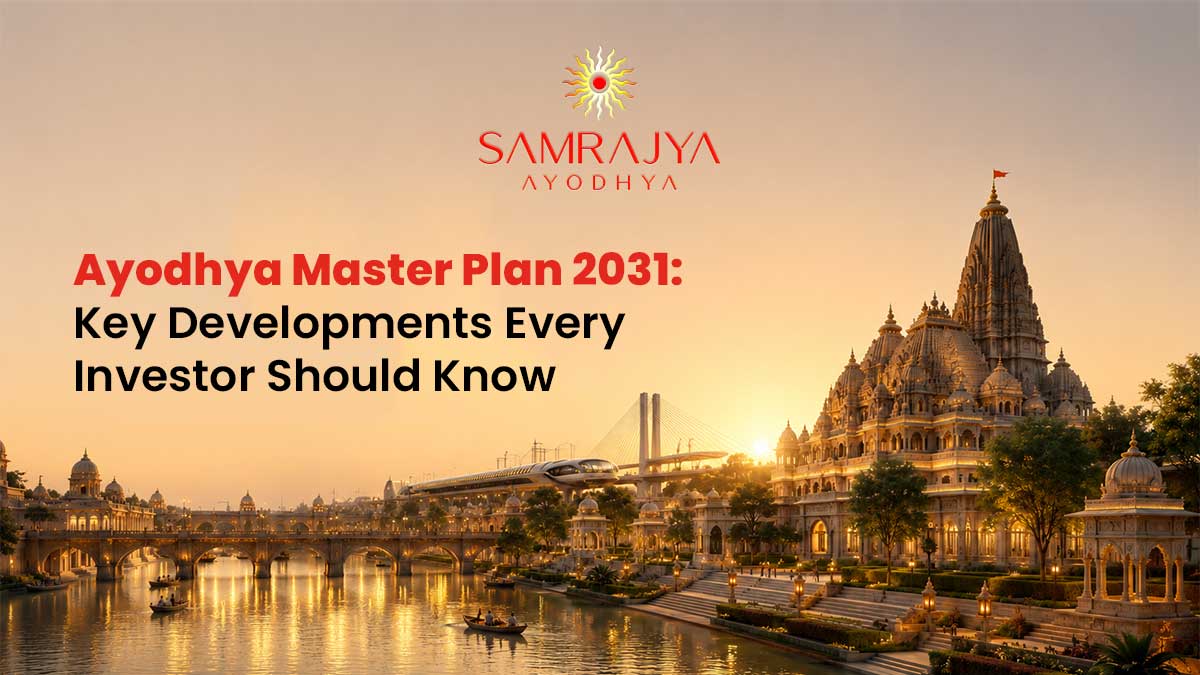
Most people invest in Ayodhya because of the Ram Mandir.
That is a good reason. But it is only half the story.
The other half is a ₹85,000 crore government blueprint that is systematically rebuilding Ayodhya from the ground up, roads, airport, townships, riverfront, smart city systems, and an entirely new city on the outskirts. That blueprint is the Ayodhya Master Plan 2031.
If you are investing in Ayodhya without understanding this plan, you are making decisions with incomplete information.
Here is everything you need to know.
Want to invest in tomorrow's real estate hotspots? Click here
What Is the Ayodhya Master Plan 2031?
The Master Plan 2031 is a government-backed urban development blueprint prepared by the Ayodhya Development Authority (ADA). It covers the current city and has now been expanded to 873 sq. km, Incorporating 343 villages from neighbouring Basti and Gonda districts.
The plan's core goals:
- Support a projected population of 14 lakh (1.4 million) by 2031
- Handle annual footfall projected to reach 50 crore visitors
- Build Ayodhya into a "Global Spiritual Capital"
- Balance modern infrastructure with heritage preservation
Total government spending committed under this plan: over ₹85,000 crore, and that excludes national connectivity and defence projects running parallel to it.
Want to invest in tomorrow's real estate hotspots? Click here
Key Development 1: New Townships Being Built From Scratch
This is the most significant thing happening in Ayodhya right now that most investors are not tracking closely enough.
Navya Ayodhya (Green Field Township)
- 1,407-acre smart township being developed near the NH-27 bypass
- Investment of approximately ₹2,180 crore by UP Awas Evam Vikas Parishad (UPAVP)
- Designed as a sustainable Vedic city with underground utilities
- Includes a Green-Blue Corridor linked to the Saryu River
- Dedicated sectors for State Bhavans, international guest houses, and high-end residential plots
- Plot allotments for Sectors 8A, 8C, and 9A began in late 2025
- Infrastructure completion targeted between 2028 and 2030
New Ayodhya Township
- 1,000-acre township being developed separately by the UP government
- India's first vastu-based township
- Blends contemporary and traditional architecture with a focus on sustainability
Vashisht Kunj Yojna
- Managed by ADA directly
- Focused on organised residential clusters for the growing middle-class and professional population moving into the city
These townships are unlocking land corridors that were previously outside investor radar. Areas adjacent to these projects are seeing early appreciation before they even get built.
Want to invest in tomorrow's real estate hotspots? Click here
Key Development 2: Airport That Changes the Connectivity Game
The Maharishi Valmiki International Airport is operational. But what is coming next is bigger.
What is already running:
- Handling 10 lakh passengers annually in Phase 1
- Connected to 13 cities including Mumbai, Delhi, Bengaluru, Kolkata, and Hyderabad
- International flights expected from September 2026
What is coming:
- Phase 2 expansion already underway
- Capacity will scale to handle significantly higher volumes
- Cargo hub capable of handling 2.5 lakh metric tonnes per year, expandable to 18 lakh metric tonnes
An airport does not just help travellers. It anchors hotel demand, logistics businesses, and commercial activity in a radius around it. Every zone between the airport and the Ram Mandir is sitting on a highway of potential footfall.
Key Development 3: Road Network Being Rebuilt
The government is spending ₹12,000 crore through NHAI alone on widening the regional road network around Ayodhya. Add to that ₹3,935 crore for the Bharatmala Bypass, and what you get is a city being comprehensively reconnected to every major urban centre around it.
Roads already built or under active development:
- Ram Path — 9.7 km, 4-lane, connecting railway station to Ram Mandir
- Bhakti Path — linking key religious sites across the city
- Janmabhoomi Path — direct access corridor to the temple
- Parikrama Marg — 15 km ring road around the Ram Mandir complex
- Ayodhya Bypass — 67.57 km, 4/6 lane northern and southern bypass under construction
- Dharma Path — under construction, additional temple access corridor
Property values along every one of these corridors have already moved. The bypass and newer corridors still have an appreciation runway ahead.
Key Development 4: Sarayu Riverfront and Tourism Infrastructure
The Sarayu Riverfront development has converted what was a basic ghaat into a structured tourism destination.
What is there now:
- Cafes, restaurants, and food stalls
- Watersports facilities
- Light-and-sound show
- Ram Ki Paidi ghaat upgrades
What is coming:
- India's first 5-star pure vegetarian luxury hotel on the Sarayu, operated by The Leela Palaces, Hotels and Resorts
- More high-end riverfront hospitality projects in planning
The CEO of The Leela said publicly that Ayodhya will become one of the five or six must-visit destinations in India. When a group like The Leela makes that statement while signing a project, it is not marketing. It is a business call.
Want to invest in tomorrow's real estate hotspots? Click here
Key Development 5: Smart City Infrastructure
The Ayodhya Smart City Plan is running parallel to all the physical infrastructure.
What is being implemented:
- AI-based traffic management systems
- Digital governance systems for residents and tourists
- Scientific waste segregation and eco-friendly disposal
- Green belts, parks, and expanded tree plantation zones
- Upgraded power supply across the city
- Improved drainage systems and pedestrian infrastructure
- Surveillance systems across major corridors
This is the difference between a city that handles tourism and a city that is built for it. Ayodhya is being built for it.
Key Development 6: Building Height Restrictions Near the Temple
This one matters for investors specifically.
Under the Master Plan 2031, building heights near the Ram Mandir are restricted to a maximum of 17.5 metres for non-religious structures. The inner periphery around the temple has even stricter development controls.
What this means for investors:
- Quality commercial inventory near the temple is permanently constrained by regulation
- The number of eligible commercial units in the highest-footfall zones cannot grow beyond a certain point
- Limited supply + growing footfall = sustained upward pressure on commercial property values near the temple
This is not something that changes with a new government or a market cycle. It is written into the master plan itself.
What Zones Should Investors Focus On?
Based on the Master Plan 2031, analysts and market reports point to several high-potential investment zones:
High footfall, premium pricing (already moved significantly):
- Ram Mandir corridor, within 1 to 3 km
- Ram Path, Bhakti Path, Janmabhoomi Path corridors
- Rakaabganj, Devkali, Avadh Vihar (highest circle rates post-revision)
Mid-zone with strong growth runway:
- 3 to 8 km from the temple
- Airport Road and Faizabad bypass corridor
Emerging zones with early-mover potential:
- Navya Ayodhya township area (NH-27 bypass)
- Ring road and outer bypass corridors
- Areas adjacent to the new township developments
Where Samrajya Fits in This Picture
The Master Plan 2031 makes one thing very clear. The highest-value commercial real estate in Ayodhya will always be in the zone directly adjacent to the Ram Mandir, on the roads that connect the city to the temple, and within walking distance of the 2 to 3 lakh daily visitors who arrive every single day.
Samrajya Ayodhya by Starling Group sits exactly here.
Located just 1 km from the Ram Mandir on VIP Road, the project sits within the master plan's highest-footfall commercial zone. It offers commercial studio apartments, retail shops, and food court spaces, asset types specifically suited to a high-footfall, supply-constrained environment.
The project has direct highway connectivity to Lucknow, Gorakhpur, and the international airport corridor. Starling Group brings 30+ years of delivery experience across Delhi-NCR and Uttarakhand, important in a market where many developers are entering Ayodhya for the first time.
The Master Plan 2031 is building the city around the temple. Samrajya is built at the centre of it.
The Bottom Line for Investors
The Ayodhya Master Plan 2031 is not just an urban planning document. It is a ₹85,000 crore investment thesis backed by the government of India's largest state.
What it tells investors:
- Ayodhya is being built to handle 50 crore annual visitors
- New townships, roads, airports, and smart infrastructure are all running simultaneously
- Building regulations near the temple permanently constrain prime commercial supply
- Every corridor project creates new appreciation zones as it gets built
The question is not whether Ayodhya will grow. The plan makes that inevitable. The question is where you position yourself within it, and how early.