
Blog
Published On: 13/07/2026
Why Samrajya Ayodhya Chose This Exact Location, The Story Behind the Site Selection
Discover why Starling Group selected VIP Road for Samrajya Ayodhya. Explore the location strategy, Ram Mandir proximity, connectivity, and investment potential.
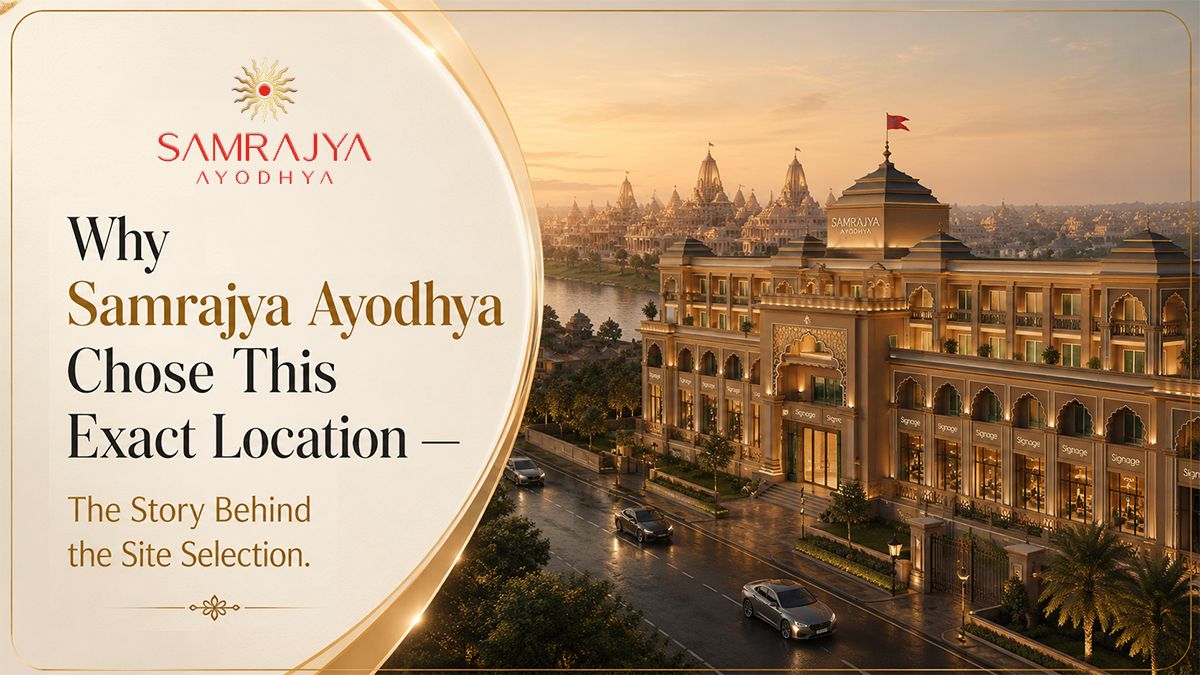
When Starling Group was evaluating where to build their Ayodhya project, they did not start with a plot. They started with a question.
Where do 2 to 3 lakh visitors actually go every single day?
The answer to that question, studying footfall data, visitor movement patterns, highway access, and Ayodhya's evolving city plan, led them to one address: VIP Road, 1.2 km from the Ram Mandir.
Here is the thinking behind that decision.
Discover How This Property Could Deliver 2X Returns in the Coming Years
The Ayodhya Site Selection Problem
Ayodhya is not a small city anymore. After the Pran Pratishtha of the Ram Mandir in January 2024, the city exploded in footfall and investor interest simultaneously. Plots were available across dozens of zones, from the core temple corridor to peripheral zones 15 to 20 km away.
Every zone had its advocates. The peripheral zones were cheaper. The outer ring road offered lower entry prices and longer appreciation runways. The airport corridor was generating buzz.
But for a commercial project, one designed to generate monthly rental income from retail, food courts, and short-stay studios, the only variable that truly mattered was this: how many people walk past your door every day?
The answer to that question pointed clearly to one zone. The 0 to 2 km radius around the Ram Mandir.
Discover How This Property Could Deliver 2X Returns in the Coming Years
Why the Ram Mandir Corridor Is Different from Every Other Zone
In most Indian cities, commercial real estate value is driven by proximity to employment. Offices, IT parks, business districts, these are the anchors.
Ayodhya is fundamentally different. Its commercial anchor is the Ram Mandir, and unlike an office park that operates for 8 hours and closes on weekends, the Ram Mandir draws visitors 365 days a year, every hour of the day.
The numbers make this stark.
22 crore people visited Ayodhya in 2025. That is more than the Taj Mahal. The daily average works out to 2 to 3 lakh visitors, with peak days significantly higher during Ram Navami, Deepotsav, and other festivals.
Every single one of those visitors walks through the corridors closest to the Ram Mandir. They eat nearby. They stay nearby. They shop nearby. The commercial property that sits in this path captures a share of that spending every single day, not seasonally, not when markets are good, not when a company hires more people.
Every day. Without fail.
This is why the core 0 to 2 km zone around the Ram Mandir is a different category of commercial real estate from anything else in Ayodhya, \ and why the site selection process for Samrajya began and ended here.
Discover How This Property Could Deliver 2X Returns in the Coming Years
Why VIP Road Specifically
Within the Ram Mandir corridor, VIP Road stood out for several specific reasons.
- Direct temple access without congestion- VIP Road provides one of the most direct and well-maintained routes to the Ram Mandir. During peak pilgrim seasons, the road sees heavy footfall from both vehicular drop-offs and pedestrian movement. Visitors staying or eating near VIP Road have straightforward access to the temple and back, which matters significantly for short-stay accommodation demand.
- Highway connectivity from multiple directions- VIP Road connects directly to the Six-Lane Lucknow-Ayodhya-Gorakhpur Highway, one of the most important arterial connections in this part of Uttar Pradesh. This means visitors arriving from Lucknow, Gorakhpur, Varanasi, and beyond pass through or near VIP Road as they approach the city. It is not a dead-end location. It is a through-route for the majority of Ayodhya's visitors.
- Airport corridor access- The Maharishi Valmiki International Airport is now operational. VIP Road, connected to the main highway network, provides direct access to and from the airport corridor. As international flights scale through 2026 and 2027, this connectivity becomes increasingly relevant for the short-stay accommodation market.
- Walking distance from Ayodhya Dham Railway Station- The fully redeveloped Ayodhya Dham Railway Station is within accessible distance from the VIP Road zone. For the majority of pilgrims who arrive by train, which remains the primary mode of arrival for most visitors, this proximity is critical.
Discover How This Property Could Deliver 2X Returns in the Coming Years
What the Master Plan Said
Site selection for a serious commercial project requires more than footfall counting. It requires understanding what the city's regulatory framework will look like over the next decade.
The Ayodhya Master Plan 2031, a ₹85,000 crore urban development blueprint, told a very clear story about the VIP Road zone.
Building height restrictions near the temple: The Master Plan imposes height limits on new construction within the inner temple periphery. This means the number of quality commercial units that can be built in the highest-footfall zones is permanently capped by regulation. It will not increase significantly regardless of how many developers want to build there.
This is one of the most important investment insights in the Ayodhya market. Limited supply plus growing demand equals sustained commercial property value. And the supply cap is written into the Master Plan itself, it is not dependent on market conditions or developer decisions.
The VIP Road zone sits within this regulated corridor. Samrajya Ayodhya is one of the limited number of projects that can legitimately offer commercial real estate in this zone.
The Commercial Asset Mix Decision
Once the location was confirmed, the next question was: what to build?
Ayodhya's demand structure, 2 to 3 lakh daily visitors who are pilgrims and tourists, pointed clearly to three specific commercial asset types:
Commercial studio apartments: Ayodhya's short-stay accommodation demand is enormous and largely unmet by existing hotel supply. Managed studio apartments in the temple corridor provide a private, comfortable alternative for visitors who want more than a hotel room at a competitive price. Hotels need to nearly triple by 2031 just to meet current demand.
Retail shops: Visitors buy prasad, religious items, clothing, gifts, and souvenirs. Retail space on a high-footfall road in the temple corridor is occupied the moment it is handed over.
Food court spaces: 2 to 3 lakh people need to eat every day in Ayodhya. F&B is the fastest-growing commercial segment in the city, restaurants went from 200 to nearly 2,000 in two years. Well-located food court spaces have among the lowest vacancy rates of any commercial category in the city.
This is the logic behind Samrajya's three-product mix, not a developer preference, but a demand-driven decision anchored in what the market is actually asking for.
What ₹62- 65 Lakh Buys You in This Location
In most high-footfall commercial zones in India, premium malls in metros, airport-adjacent commercial zones, established IT park corridors, the entry price for commercial real estate is significantly higher.
In the Ram Mandir corridor, the window for entry at ₹62 lakh* is still open, but it is closing. Circle rates in Ayodhya were revised upward by 30 to 200% in 2025. Post the Pran Pratishtha, prices in prime zones moved sharply. This is still not Mumbai, Bengaluru, or even Varanasi pricing.
The combination, prime location, right asset types, entry price that still makes the income math work, and a developer with 30+ years of delivery track record, is what made Samrajya possible at this address.
Discover How This Property Could Deliver 2X Returns in the Coming Years
Starling Group's Perspective
Starling Group has delivered real estate projects for over three decades across Delhi-NCR and Uttarakhand. They have seen multiple market cycles, the boom, the correction, the slow recovery, the next boom.
Their consistent observation across those cycles is that the projects that deliver for investors are not the most elaborate or the most heavily marketed. They are the ones where the fundamental logic is sound, the right location, the right product for that location, and execution that delivers what was promised.
Ayodhya's VIP Road, 1.2 km from the Ram Mandir, is a location where the fundamental logic is as clear as it gets in Indian real estate today. 2 to 3 lakh daily visitors. Permanent demand anchor. Limited supply by regulation. Growing infrastructure around it. And a market that, despite years of sharp appreciation, still has a meaningful runway ahead.
That is why Samrajya Ayodhya is where it is.
Visit Samrajya Ayodhya
The best way to understand why this location works is to stand on VIP Road and watch the city move around you.
Site visits are open. The sales team will walk you through the project, the location, and the income projections in detail.
Samrajya Ayodhya by Starling Group Commercial studio apartments, retail shops, and food court spaces. 1.2 km from Ram Mandir on VIP Road, Ayodhya. Starting at ₹62 lakh*.